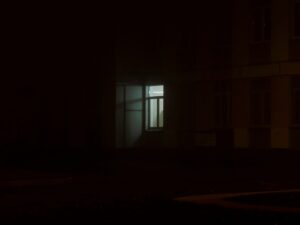
無響室で聴こえてくるもの 『Anechoic』について

無響室に入ったことがある人は、あまり多くないと思います。壁も床も天井も、すべての反響を吸収するように設計された部屋。外の音は完全に遮断され、世界でいちばん静かな場所のはずなのに、そこに立つと、二つの音が聴こえてきます。自分の血液が流れる音と、神経系が発する高い音。つまり、完全な静寂を手に入れた瞬間に、人間は自分自身の身体を聴きはじめるのです。
沈黙とは、音がない状態ではない。外の音が消えたとき、内側にあったものが立ち上がってくる状態のことだ。この発見が、8月14日にリリースするEP『Anechoic』の出発点になりました。
この構造に、私は既視感がありました。村上春樹さんの『世界の終りとハードボイルド・ワンダーランド』です。あの小説は、二つの物語が交互に進みます。情報が氾濫し、音に満ちた東京を疾走する「ハードボイルド・ワンダーランド」。そして、高い壁に囲まれ、心を失った人々が静かに暮らす「世界の終り」。騒がしい外界と、壁の内側の静謐な内面世界。読み進めるうちに、二つの世界が実はひとつの意識の表と裏だったことがわかっていく。
無響室とは、あの「壁に囲まれた街」の音響的な姿ではないか。外部の音をすべて剥ぎ取ったとき、そこに現れるのは空虚ではなく、自分の内側でずっと鳴り続けていたもの。『Anechoic』の5曲は、その部屋に入ってから出るまでの、ひとつの旅として並んでいます。
1曲目「Anechoic」は、部屋の入口です。弦楽、オーケストラの書法、電子音響が、緊張と対話のなかで共存します。ここでは不協和音と沈黙そのものを、旋律と同じ資格を持つ「素材」として扱いました。心地よさのためではなく、耳の感度を変えるための曲です。
2曲目「Memories」。外の音が消えた部屋で最初に浮かび上がってくるのは、記憶です。思い出そうとして思い出すのではなく、静けさの中で勝手に立ち上がってくる種類の記憶。
3曲目「After the Silence」は、このアルバムの中心にある曲で、オーストリアのChristian Fenneszとの共作です。私たちは二人とも坂本龍一さんの仕事に深く関わってきましたが、二人で録音したことは一度もありませんでした。私が東京で弾いた静かなピアノのスケッチを、ほとんど問いかけのように彼に送ったところ、数週間後、想像もしなかった形でエレクトロニクスの層をまとって返ってきた。まるで私の演奏の中の沈黙が、彼の住み着く空間になっていたかのように。タイトルの「沈黙のあと」とは、坂本さんが遺していった大きな静寂のあとに、何が立ち現れてくるのかという、私たち二人にとって切実な問いでもあります。
4曲目は、エリック・サティの「ジムノペディ」をAOKI takamasaさんがリミックスしたもの。5曲目「Satie’s Dream」は、そのサティへの応答です。サティは百年以上前に「家具の音楽」を夢想しました。注意を要求せず、部屋の空気のようにそこにある音楽。聴かれることを主張しない音楽という彼の夢は、無響室の思想と、静かにつながっています。アルバムはこの曲で、部屋の扉を開けて外に出ていきます。
つくり終えてから、面白いことが起きています。この「沈黙の問い」が、言葉の壁を越えて届きはじめているのです。シアトルの公共ラジオKEXPが番組「Pacific Notions」で「After the Silence」をかけてくれました。Stationary Travelsは、リリース前日にこの曲を「魅惑的で没入感のある音楽」としてプレミア紹介してくれました。英国の音楽誌The Wireや、米国のポッドキャストThe Tonearmからも声がかかり、Spotifyでは8つのエディトリアル・プレイリストに選ばれています。国も言語も違う聴き手たちが、同じ静けさの中で何かを聴き取ろうとしてくれている。音楽が言葉より先に届くことを、あらためて実感しています。
騒がしい毎日の、どこか10分でかまいません。イヤホンでも、部屋のスピーカーでも。外の音を少しだけ小さくして、この小さな無響室に入ってみてください。静寂のあとに、あなた自身の内側から何が聴こえてくるか。それがこのアルバムの、本当の最終トラックです。
『Anechoic』は8月14日、CROIX / electric sheepよりリリース。先行シングル「After the Silence」は各ストリーミングサービスで配信中です。
特設サイト https://bajune.com/release/anechoic/
What You Hear in an Anechoic Chamber. On “Anechoic”
Not many people have stood inside an anechoic chamber. It is a room designed to absorb every reflection: walls, floor, ceiling. All outside sound is sealed away. It should be the quietest place in the world. And yet, standing there, you begin to hear two sounds: the low pulse of your own blood circulating, and the high tone of your nervous system at work. The moment you finally attain perfect silence, you begin to listen to your own body.
Silence, in other words, is not the absence of sound. It is the state in which, once the outside world falls away, what was always inside you rises to the surface. That discovery is the starting point of Anechoic, my new EP releasing August 14.
The structure felt strangely familiar to me. It was the structure of Haruki Murakami’s novel Hard-Boiled Wonderland and the End of the World. The book runs on two alternating narratives: the “Hard-Boiled Wonderland” of a noisy, information-saturated Tokyo, and the “End of the World,” a silent town surrounded by a high wall, where people live quietly, having surrendered their minds. A clamorous outer world, and a still inner one behind the wall. As you read on, you come to understand that the two worlds are the front and back of a single consciousness.
Isn’t an anechoic chamber the acoustic form of that walled town? When every external sound is stripped away, what appears is not emptiness, but something that had been sounding inside you all along. The five tracks of Anechoic are sequenced as a single journey, from the moment you enter that room to the moment you leave it.
Track one, “Anechoic,” is the doorway. Strings, orchestral writing, and electronics coexist in tension and conversation. Here, dissonance and silence are treated as compositional materials in their own right, with the same standing as melody. It is not a piece for comfort; it is a piece that changes the sensitivity of your ears.
Track two, “Memories.” In a room where the outside has gone quiet, the first thing to surface is memory. Not the kind you summon deliberately, but the kind that rises on its own out of the stillness.
Track three, “After the Silence,” is the centerpiece of the album, a collaboration with the Austrian musician Christian Fennesz. Both of us have been deeply involved in the work of Ryuichi Sakamoto, yet we had never once recorded together. I sent Christian a quiet piano sketch I had played in Tokyo, almost as a question. Weeks later it came back wearing layers of electronics I could never have imagined, as if the silences in my playing had become spaces for him to inhabit. The title, “After the Silence,” is also an urgent question for the two of us: what emerges after the vast quiet that Sakamoto left behind?
Track four is Erik Satie’s “Gymnopédie,” remixed by AOKI takamasa. Track five, “Satie’s Dream,” is my response to Satie himself. More than a century ago, Satie dreamed of “furniture music,” music that demands no attention, music that simply exists in a room like air. His dream of music that does not insist on being listened to is quietly connected to the idea of the anechoic chamber. With this track, the album opens the door and steps back outside.
Since finishing the record, something interesting has been happening: this question about silence has begun crossing the language barrier. KEXP, the Seattle public radio station, played “After the Silence” on its program Pacific Notions. Stationary Travels premiered the track the day before release, calling it “a mesmerizing and immersive piece of music.” The Wire in the UK and the American podcast The Tonearm have reached out, and the track has been added to eight Spotify editorial playlists. Listeners in different countries, in different languages, are trying to hear something in the same stillness. It reminds me that music arrives before words do.
Somewhere in your noisy day, find ten minutes. Headphones are fine; so is a speaker in your room. Turn the outside world down just a little, and step into this small anechoic chamber. After the silence, what will you hear rising from inside you? That is the album’s true final track.
Anechoic will be released August 14 via CROIX / electric sheep. The lead single “After the Silence” is streaming now on all platforms.
Album page:
https://bajune.com/release/anechoic/